Society for the History of the Humanities

  • Society for the History of the Humanities
  • News
  • About the Society
  • Members
  • Meetings
    • Upcoming
      • Digital Round Table on Global Perspectives on the History of the Humanities
      • The Making of the Humanities XII, Toruń 2026
    • Previous
      • Amsterdam 2008
      • Amsterdam 2010
      • Rome 2012
      • Rome 2014
      • Baltimore 2016
      • Oxford 2017
      • Amsterdam 2018
      • Cape Town 2019
      • Barcelona 2021
      • Pittsburgh 2022
      • Digital Workshop: Epistemic transfer 2023
      • Working group: History of the Language Sciences
      • The Making of the Humanities XI, Lund 2024
      • Digital Event: Workshop on Comparative Methods and their Histories
    • Board of Events
  • Resources
  • Courses
  • The Journal

January 7, 2020 By admin

“The Centre Must Fall”: Reflections on The Making of the Humanities VIII conference in Cape Town

The following is a translation of a blog post written by Hampus Östh Gustafsson, Uppsala University, for the blog Humtank. The text was originally published in Swedish.

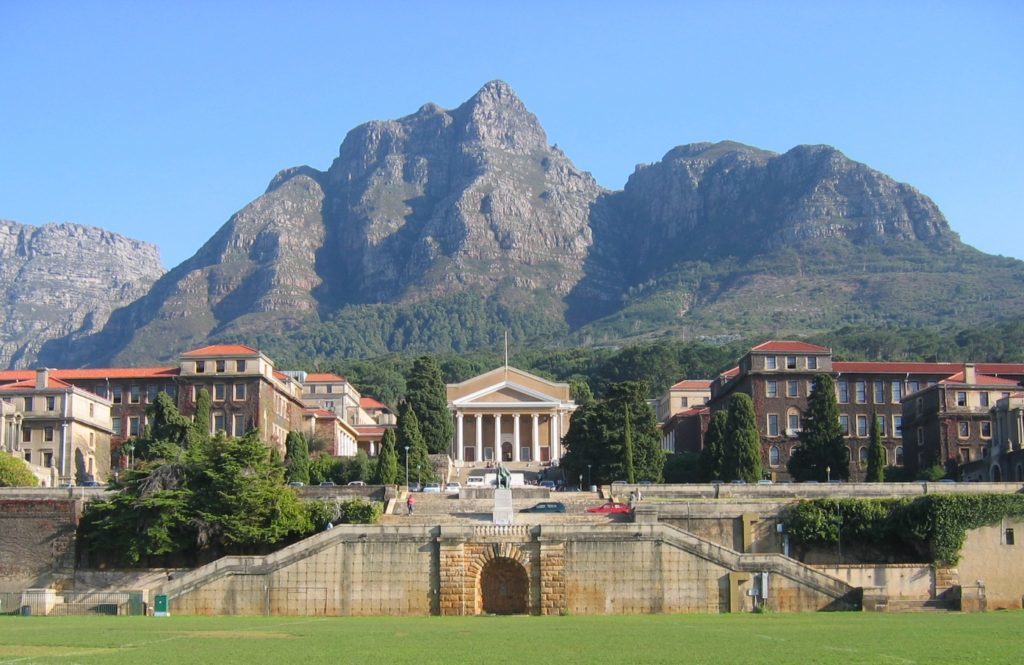
University of Cape Town

“The Centre Must Fall”: Reflections on Global Humanities

In this blog post, Hampus Östh Gustafsson describes the discussions on global opportunities and challenges held at the recent Making of the Humanities VIII conference in Cape Town. The troubled past of South Africa provided a special framework, and soon it became apparent that the notion of a crisis in the humanities is prevalent there as well. The polycentric focus of the conference, however, opened up new ways of addressing the history and current state of the humanities.

The fact that the conditions of the humanities vary in time and space should be a matter of course – yet, astonishingly little consideration is given to this trivial starting point. As a result, debates about the state of the humanities often become vague or miss their mark. Attempts have recently been made to approach the alleged crisis of these subjects in novel ways, focusing in particular on how an eventual crisis should be interpreted from a global perspective. Such comparative projects, however, come with many difficulties. In the same way that it is risky to speak of the humanities as a monolith, problems arise in connection with transnational comparisons of environments with varying academic systems and cultures of knowledge. Is it really the same categories that are being compared?

Against this background, scholars within the field of History of Humanities met on 21st–23rd November 2019 for a conference at the University of Cape Town. The initiators of the field have eagerly stressed an ambition to be globally inclusive. This year’s theme, “Decentralizing the Humanities”, was thus well chosen. In the following, I would like to recap some reflections that were raised during the conference. The choice of a location with such a troubled past contributed to an uncovering of new aspects of the history of the humanities. Still, it took until the last day of the conference before a question that everyone seemed to have awaited was finally put: should one not, in a country marked by racism, huge socioeconomic differences and a violent past, expect subjects such as history to be considered very important, making the notion of a crisis in the humanities irrelevant? The answer turned out to be far from obvious. On the contrary, a number of challenges faced by the African humanities were mentioned. For instance, one participant described how South African youths sometimes display a kind of fatigue when they are about to enter universities since they, in school, already have spent so much time on certain historical narratives, as if history is almost too present to have a positive effect on the state of the humanities.

The issue of a humanities crisis in South Africa has already been addressed in academic literature, for instance in the recent anthology The Changing Face of Higher Education: Is There An International Crisis in the Humanities? (Routledge, 2019), consisting of national case studies from all continents. The various chapters raise the question of whether it is meaningful at all to talk about a crisis in the humanities, or even to expect a yes or no answer to the question of whether there exists one. This is partly due to the fact that crisis narratives of the humanities are usually formulated in relation to notions of a golden age. In the case of South Africa, historian Keith Breckenridge pointed out how the history of the humanities within the academic system is briefer compared to many other former colonies as the universities were formally established after the First World War. Characteristic golden age narratives are thus missing, but nevertheless it turns out that South Africa has gone quite far regarding the issue of a “crisis”.

In 2013, the government even officially proclaimed that there was a crisis in the humanities. The action was prompted by a report submitted two years earlier by The Academy of Science of South Africa, describing a crisis based on scarce student enrolments and a lack government support. These problems are easily recognizable from Western  discussions, but the report also identified a fundamental need for the South African humanities to reach out internationally. This touched upon a question discussed at the conference as several participants, working in different countries in the Global South, claimed to have great difficulties speaking with as strong a voice as researchers from the Global North. For example, representatives of the African Humanities Program presented their work to improve the conditions for African scholars, not least by creating incentives for accepting invitations to other universities on the continent instead of only seeing the prestige of visiting Western universities. At the same time, the international imbalance is reflected by inequalities within African academia where far from all scholars and students face the same opportunities.

That the academic world of South Africa is filled with tensions became very clear given that the conference was held on the campus where the eventually worldwide #RhodesMustFall movement began in 2015. Since then, harsh criticism has been directed against racism and an overly slow rate of change regarding the decolonialisation of academic institutions. One of the conference participants, literary historian John Higgins, recently noted in the anthology Poverty and Inequality: Diagnosis, Prognosis and Response (HSRC Press, 2019) how issues of, for example, academic freedom take on a special character in such an unequal society as South Africa. It must be taken into account that there are different types of inequalities, for example on an existential level, which the student protests made clear. Academic freedom is usually seen as an abstract right but then overlooks material conditions that might be decisive regarding who will be included and not.

Here, Higgins refers to the German 18th century university reformer Wilhelm von Humboldt. In debates on universities, it is common that categories such as academic freedom are being discussed with reference to Western traditions as if they were of universal validity. Similar problems were repeatedly highlighted in Cape Town. From a global point of view, there is an asymmetry regarding how the history of the humanities has been treated so far. For instance, in one of the conference’s keynote lectures, musicologist and composer Martin Scherzinger pointed out how Western music is usually studied from a variety of musicological perspectives while African music tends to be approached with anthropological methods. In another presentation on Khoisan studies, it was emphasised that African languages are regularly regarded as ancient and static due to an ahistorical attitude that current research needs to address. This problem derives from the fact that much African scholarship has grown out of colonial traditions.

The problem was addressed already in the first keynote lecture. In a nuanced way, sociologist Elisio Macamo discussed (not without influences from Baudrillard) how Africa can be made into an object of study without simultaneously becoming invisible, which tends to be the paradoxical effect when method and concepts are retrieved from other contexts. Macamo began by asking what he must sacrifice to be an African scholar, what it means to take on such an imposed (Western) identity. It has been difficult for African intellectuals to seriously protest against the colonial systems of knowledge. For example, the challenges were addressed in a panel discussion on how academic journals served as a kind of “gatekeeper” during the apartheid era and how one today may relate to an institutionalised production of knowledge that has been so exclusive. Macamo believed that African studies are needed precisely to teach us how to study Africa, but also to gain deeper insights into fundamental questions about the societal conditions of knowledge.

This conclusion was in line with the conference organisers’ request for polycentric perspectives, which may highlight other types of connections and parallels, ruptures and continuities. Global approaches can uncover widespread myths in the history of the humanities, for example narratives assuming that everything would have started with ancient Greece via Renaissance humanism and the Enlightenment and so on. At the same time, the challenges are many when ascending onto a global level. Is it possible to access different knowledge centres in equivalent ways? Sometimes there is also a great lack of source material, although extensive discoveries have been made in recent decades, not least in Timbuktu. Such discoveries may, in the context of the polycentric expansion, contribute to novel ways of thinking, but it is essential to ensure that this does not stop at fluffy catch-words.

Somewhere at this point the discussions of the conference ended. So, what should we bring from there? Here I need to add that I spontaneously intended to give this brief conference report the title “The Center Cannot Hold”, but soon I realized that it would be both a cliché and insufficient – yet another proof of how difficult it is to tear yourself away from Western interpretive frameworks (although Yeats himself also reacted to a colonial power). Hopefully, the heading I finally selected better captures what the conference brought to light. The polycentric point of departure is a methodological call, but also concerns a basic ethical (self-)consciousness that should characterise any attempt to conduct research in the humanities. Not surprisingly, the question was thus asked, almost before the conference started, how sound it is to fly scholars across the globe in the time of climate crisis – a crisis particularly visible in Cape Town, whose water shortage recently became acute. In addition, the infrastructure was impaired due to airline strikes and cancelled trains, which meant that several participants never showed up.

I still hope that the conference fulfilled its mission: working as a contribution to a new kind of historiography. The global consciousness reminds us of the importance of uncovering geographical – but also historical – nuances when we talk about the societal role of the humanities and seek to develop successful claims for their justification. In fact, it is strange that many people seem to be looking for some kind of magical, universal key argument in defence of the humanities. Rather, we need different claims for their value, which may be combined in different ways depending on which problems that are being raised in specific contexts. We cannot expect the humanities to play the same part everywhere, always. That should be a central insight for anyone interested in the history of the humanities.

Hampus Östh Gustafsson, PhD student in History of Science and Ideas, Uppsala University.

Filed Under: Uncategorized

December 13, 2019 By admin

Call for Papers and Panels ‘The Making of the Humanities IX’, Barcelona

Barcelona, 20-22 September, 2021

UPDATE APRIL 2020: DUE TO COVID-19, THIS CONFERENCE HAS BEEN POSTPONED UNTIL 2021. PLEASE CHECK THE NEW DEADLINE BELOW!

‘The Making of the Humanities’ conference goes to Barcelona! The Universitat Pompeu Fabra (UPF) together with the Universitat Oberta de Catalunya (UOC) will host the 9th Making of the Humanities conference, from 20 till 22 September 2021, at the facilities of the UPF Faculty of Humanities, Ciutadella Campus, Jaume I building.

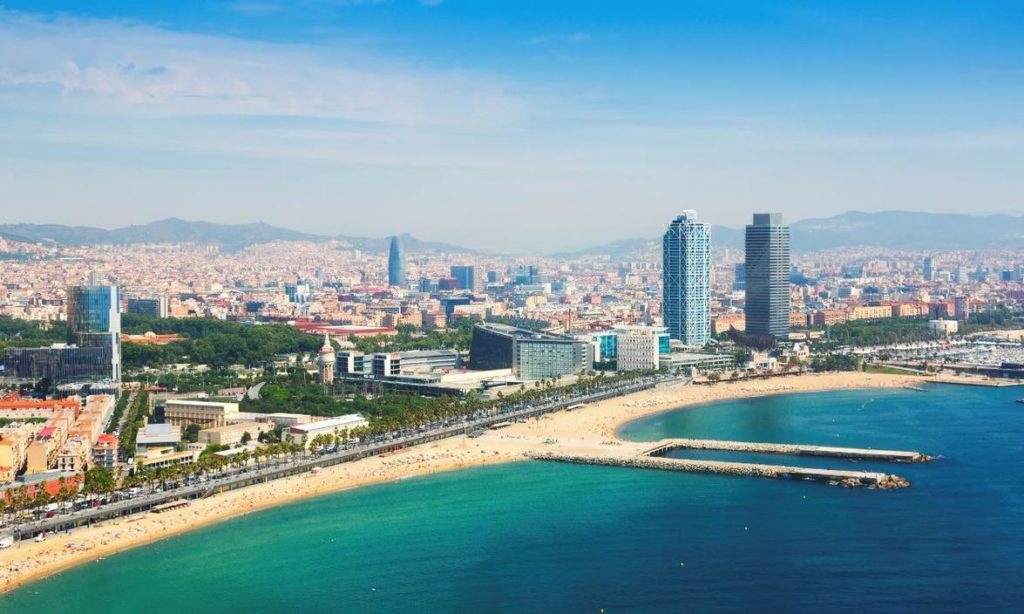
Barcelona

Goal of the Making of the Humanities (MoH) Conferences

The MoH conferences are organized by the Society for the History of the Humanities and bring together scholars and bring together scholars and historians interested in the history of a wide variety of disciplines, including archaeology, art history, historiography, linguistics, literary studies, media studies, musicology, and philology, tracing these fields from their earliest developments to the modern day.

We welcome panels and papers on any period or region. We are especially interested in work that transcends the history of specific humanities disciplines by comparing scholarly practices across disciplines and civilisations.

This year there is a special conference theme. We encourage submissions that explore this theme, but remain fully open to submissions addressing other subjects.

This year’s conference theme is Unfolding Disciplines in the History of the Humanities.  

A growing body of scholarship suggests that the historiography of the humanities is increasingly organized around new interdisciplinary collaborations that affect the very understanding of what it means to belong to a Humanities discipline. This year we invite contributions that interlace different disciplinary approaches in order to frame humanistic scholarship in terms of a continued engagement with the limits and possibilities offered by the softening and even erasure of disciplinary boundaries. Participants are also encouraged to think expansively about the impact of the ongoing process of reinvention of established as well as new disciplinary fields as a result of increased cross-pollination and collaboration. 

Please note that the Making of the Humanities conferences are not concerned with the history of art, the history of music or the history of literature, and so on, but instead with the history of art history, the history of musicology, the history of literary studies, etc.

Keynote Speakers MoH-IX (Preliminary)

Cristina Dondi (Oxford University): “The history of the book and libraries: from bibliophilia to social and economic history”

Maribel Fierro (CCHS-CSIC Madrid): “Iberian humanities and the historical experience of religious pluralism”

Matthew Rampley (Masaryk University): “Naturalistic Theories in the Humanities: Past and Present”

Paper Submissions

Abstracts of single papers (30 minutes including discussion) should contain the name of the speaker, full contact address (including email address), the title and a summary of the paper of maximally 250 words. For more information about submitting abstracts, see the submission page.

Deadline for abstracts: 1 May 2021

Notification of acceptance: June 2021

Panel Submissions

Panels last 1.5 to 2 hours and can consist of 3-4 papers and possibly a commentary on a coherent theme including discussion. Panel proposals should contain respectively the name of the chair, the names of the speakers and commentator, full contact addresses (including email addresses), the title of the panel, a short (150 words) description of the panel’s content and for each paper an abstract of maximally 250 words. For more information about submitting panels, see the submission page.

Deadline for panel proposals: 1 May 2021

Notification of acceptance: June 2021

Conference fee

The exact conference fee will be determined in spring 2021 and will be ca. €100 for regular participants and ca. €80 for PhD students. The fee includes access to all sessions, access to the welcoming reception, simple lunches, and tea and/or coffee during the breaks.

Organization

Local Organizing Committee: Daniele Cozzoli (UPF), Linda Gale Jones (UPF), Tomas Macsotay (UPF) and Neus Rotger (UOC)

Program Committee: International Board of the Society

Filed Under: Uncategorized

October 30, 2019 By admin

History of Humanities, issue 4.2, is out!

The latest issue of History of Humanities has been published! It contains a Themed section on “The Classics of the Humanities”, a Forum Section on “Literary Theory in Eastern Europe”, as well as two articles, two review essays and 17 book reviews. Enjoy!

Filed Under: Uncategorized

September 17, 2019 By admin

Final Programme “The Making of the Humanities VIII”

The Making of the Humanities VIII Conference

21-23 November 2019, University of Cape Town

“Decentralizing the History of the Humanities”

Venue: The Huma seminar Room, Neville Alexander Building, Upper Campus,

University of Cape Town

PROGRAM

Day 1, 21 November 2019

8.45-9.15: Registration

9.15-9.30: Opening of the conference by Shamil Jeppie (UCT) and Rens Bod (President of the Society)

9.30-10.30: Keynote Lecture by Elisio Macamo, Centre for African Studies, University of Basel

Unmaking Africa – The Humanities and the study of what?

Chair: Shamil Jeppie, UCT

10.30-11.00: Coffee

11.00-12.30: History of the Humanities in South Africa

Chair: TBA

11.00-11.30: Menan du Plessis, Stellenbosch University

The 19th century rise—and 21st century perpetuation—of Khoisan studies as a compromised field in the context of colonial and post-colonial southern Africa.

11.30-12.00:  Bronwyn Strydom, University of Pretoria

Reflections on writing a centenary history for the Faculty of Humanities at the University of Pretoria

12.00-12.30: Reingard Nethersole, University Wits and visiting scholar University of Richmond

Textwebs 1829: Weimar, Capetown, Craigenputtock

12.30-13.30: Lunch

13.30-15.30: The History of Theory (panel)

Chair: David Shumway, Carnegie Mellon University

Premesh Lalu, University of the Western Cape

The Humanities in the Wake of Slavery

John Higgins, University of Cape Town

The Identity of Theory: Some Observations on Literary Theory in South Africa

Ulrike Kistner, University of Pretoria

(Un)Doing Critical Theory in Pretoria, 1981-1987

David Shumway, Carnegie Mellon University

Theory Journals and the Rise of Theory in Literary Studies in the U.S.

15.30-16.00 Coffee, tea

16.00-18.00: The Arts and Historiography

Chair: Rens Bod, University of Amsterdam

16.00-16.30: Petra van Langen, University of Groningen

Pioneers in musicology. National trends in the development of musicology as an academic discipline.

16.30-17.00: J. Kirk Irwin, The University of Edinburgh

Decentralized Histories of Architectural Space: Panofsky and Le Corbusier

17.00-17.30 : Daniela Merolla, Institut National des Langues et Civilisations Orientales, Paris

Co-Authorship and Subversion of Humanities: Amazigh/Berber Literary and Historical Studies

17.30-18.00: Maria Teresa Costa, Max Planck Institute for the History of Science, Berlin

The Transnational Formation of Art History through its First International Conferences

18.15-20.00: Reception with finger food at the Irma Stern Museum (http://www.irmastern.co.za/). Shuttle will be provided.

Day 2, 22 November 2019

9.30-10.30: Keynote lecture by Martin Scherzinger, New York University

African Music in the Humanities: A Critique (and a Speculation)

Chair: Rens Bod, University of Amsterdam

10.30-11.00: Coffee

11.00-12.30: History and Ethnography

Chair: Shamil Jeppie, UCT

11.00-11.30: Pieter Francois, University of Oxford

Reassessing the legacies of Henri Berr and Frederick Teggart in the context of the recent turn to global history and cultural evolution.

11.30-12.00: Zehra Tonbul, Istanbul Sehir University

The Web and the Angel of Weltverkehr

12.00-12.30: Eldar Salakhetdinov, Unisa

The Evolution of Khoisan Identity Narrative in South Africa: Discovering National Myth

12.30-13.30: Lunch

13.30-15.30: The South African academic journal: past, present and future as affective orientations (panel)

Chair: Rory du Plessis, University of Pretoria

Wemar Strydom, NWU

“Past” / Strategic encounters with whiteness: 1989 to 2001 in the Stilet archive

Siseko H. Kumalo, University of Pretoria

“Present” / An instantiation of the Black Archive

Thys Human, NWU

“Future” / So, what’s the (continued) use of publishing in Afrikaans? Notes on hopeful futurity,

Commentary: Deirdre Byrne, UNISA

15.30-16.00  Coffee, tea

16.00-18.00: Encounters

Chair: TBA

16.00-16.30: Andrew Hui, Yale-NUS College, Singapore

Confucius the Stoic: Matteo Ricci and the Encounter between Western and Chinese Philosophy

16.30-17.00: Jaap Maat, University of Amsterdam

Stoic logic, Ramist logic and a remarkable defence of Aristotle

17.00-17.30 : Floris Solleveld, Katholieke Universiteit Leuven

Language as a Specimen

17.30-18.00: Guillermo Navarro-Alvarado, University of Costa Rica

The ethnography of Edward Wilmot Blyden: from the discovery of Africas to the proposal of a Pan-African nation.

19.00: Conference dinner at Moyo Kirstenbosch (http://www.moyo.co.za). Shuttle will be provided. Dinner voucher (350 rand) must be paid at Conference Desk on 21 November

Day 3, 23 November 2019

9.30-11.00: Decentralized Historiography

Chair: Jaap Maat, University of Amsterdam

9.30-10.00: Vera-Simone Schulz, Kunsthistorisches Institut in Florenz – Max-Planck-Institut

The Swahili Coast in a Network of References to the Arab Peninsula, Persia, the Indian Ocean, the African Continent and Beyond: Polycentric Histories of Art in Coastal East Africa

10.00-10.30: Hampus Östh Gustafsson, Uppsala University

Embracing the Margins: The Challenge of 20th Century Democracy to the Scandinavian Humanities

10.30-11.00: Rens Bod, University of Amsterdam

Towards a Polycentric History of the Humanities

11.00-11.30: Coffee

11.30-13.00: The Humanities and the Digital

Chair: Rens Bod, University of Amsterdam

11.30-12.00: Menno van Zaanen, South African Centre for Digital Language Resources

Digital Humanities in South Africa

12.00-12.30: Douwe Zeldenrust, Meertens Instituut – Royal Netherlands Academy of Arts and Sciences

Collections as networks, The deconstruction of information networks in the collections of the Meertens Instituut (KNAW)

12.30-13.00: Fabian Saptouw, University of Cape Town

The Digital transfiguration of the archive

13.00-14.00: Lunch

14.00-15.45: Round Table on History of Humanities Projects and Prospects

Organization and chair: Shamil Jeppie, UCT

  • African Humanities Program
  • Human Sciences Research Council
  • Other Universals
  • History Access

Participants: Crain Soudien (Human Sciences Research Council); Fred Hendricks (Rhodes University), Adigun Agbaje. (University of Ibadan) & Nomusa Makhubu (University of Cape Town) (African Humanities Programme); Ruchi Chatuverdi (Other Universals, University of Cape Town); Suren Pillay (University of the Western Cape, Centre for Humanities Research and Other Universals), Bodhi Kar (History Access, University of Cape Town).

15.45: Closing and farewell

Filed Under: Uncategorized

  • « Previous Page
  • 1
  • …
  • 7
  • 8
  • 9
  • 10
  • 11
  • …
  • 17
  • Next Page »

Get the Latest

Subscribe to get the latest news directly in your email inbox.

Recent Posts

  • Issue 10.2 of History of Humanities has been published November 23, 2025
  • Digital Round Table: Global Perspectives on the History of the Humanities (Dec 5th) October 15, 2025
  • Call for Papers: The Making of the Humanities XII (Torun 2026) October 9, 2025
  • Celebratory issue 10.1 of History of Humanities is out! July 1, 2025

Copyright© 2025 · Society for the History of the Humanities · Log in